I learned this afternoon that the director of Fidesco USA, Denis Leblond, died in his sleep on Monday morning. He wasn't sick so his passing from this life to the next is shocking. I can only imagine the sorrow his wife, six children, four children-in-law, and five grandchildren feel with him being taken from them without warning.
Even I, who knew of Denis as an Emmanuel Community brother for years but only got to know him during my Fidesco journey, am so saddened by his death. I can hear his words of encouragement during my decision-making process and his continued encouragement once I was in the mission field. I heard from him only three days ago when he said he would look over the draft of my second mission report and get back to me after the weekend, but that email will never arrive.
Once again, I am reminded that we do not know how much time we have in this life so we need to make the most of each day: tell our family members and friends that we love them; give ourselves in the service of others; dare to radically live for Jesus; live in such a way that in our last minutes we are satisfied with the life we lived.
Please pray for the eternal rest of Denis' soul and for the consolation of his family.
Tuesday, January 28, 2014

Thursday, January 16, 2014
How Can Four Hours Stimulate So Much Joy?
.JPG) One local project I've helped at twice since arriving and have arranged my teaching schedule this term to be free every Wednesday so I can participate in it, is a morning daycare/school for ~ eighty 2-6 year olds who are the children of women who sell at the market or are prostitutes. This beautiful mission is run by the Servants of Mary of the Heart of Jesus,
a religious congregation from Brazil that has both brothers and sisters in it, and Monday through Friday, 7:30 am – 12:30 pm,
the brothers and sisters welcome the children to their property for meals, classes, games, and prayers.
One local project I've helped at twice since arriving and have arranged my teaching schedule this term to be free every Wednesday so I can participate in it, is a morning daycare/school for ~ eighty 2-6 year olds who are the children of women who sell at the market or are prostitutes. This beautiful mission is run by the Servants of Mary of the Heart of Jesus,
a religious congregation from Brazil that has both brothers and sisters in it, and Monday through Friday, 7:30 am – 12:30 pm,
the brothers and sisters welcome the children to their property for meals, classes, games, and prayers. .JPG) |
| Classroom time |
.JPG) Concretely, here is what the mission looks like and what I have done to help while there. The children start to arrive at 7:30 am and once they all get there, they are fed breakfast (a roll and a banana). I passed out the food once and the children would reach out to touch my hand
or hold my arm and wouldn't want to let go. I would caress their faces to show I was attentive to them, but then I would have to pull away to continue passing out the food. After breakfast, there is some play time as the dining room is cleaned and then the kids take turns going into the bathroom to brush their teeth and wash their faces and then change into their school uniforms. Once they are dressed, they divide into four classes based on age and are taught Kinyarwanda, English, and French. My first time there, I grabbed
a small white board that had the English alphabet on it and began to teach in
the different classrooms. I taught them,
“A for apple, B for bird, C for cat, etc,” and the English names of the safari
animals that are painted on the dining room walls. I made animal sounds and actions when
appropriate (such as “L for lion and M for monkey”) and the kids enjoyed acting
like monkeys along with me. After the classes finish, lunch
is served (one time it was rice with peas, green beans, and meat mixed together) and then we
all go outside to play and to wait for their parents or older siblings to pick them up.
Concretely, here is what the mission looks like and what I have done to help while there. The children start to arrive at 7:30 am and once they all get there, they are fed breakfast (a roll and a banana). I passed out the food once and the children would reach out to touch my hand
or hold my arm and wouldn't want to let go. I would caress their faces to show I was attentive to them, but then I would have to pull away to continue passing out the food. After breakfast, there is some play time as the dining room is cleaned and then the kids take turns going into the bathroom to brush their teeth and wash their faces and then change into their school uniforms. Once they are dressed, they divide into four classes based on age and are taught Kinyarwanda, English, and French. My first time there, I grabbed
a small white board that had the English alphabet on it and began to teach in
the different classrooms. I taught them,
“A for apple, B for bird, C for cat, etc,” and the English names of the safari
animals that are painted on the dining room walls. I made animal sounds and actions when
appropriate (such as “L for lion and M for monkey”) and the kids enjoyed acting
like monkeys along with me. After the classes finish, lunch
is served (one time it was rice with peas, green beans, and meat mixed together) and then we
all go outside to play and to wait for their parents or older siblings to pick them up..JPG) What is so touching about the mission is the love and care I am able to give to the children. I don't know if it is because I am white, but the kids love to be with, and on, me. When I stand, they hug me and fight over who can hold onto my hands and arms. When I sit, they rush to sit on my lap and gather around me. They stroke my hair, touch
my arms and my face, compare my religious medals on my
necklace to theirs, pull my arms around their shoulders, and hold my hands. I don't mind this invasion of personal space at all. I usually laugh and offer them the
affection they want by rubbing my hands through their hair (or stubble),
caressing their faces, tickling their necks and sides, and letting them use me as
their chair/pillow/backrest. I look forward to having Wednesdays mostly free so I can serve weekly at this mission of joy.
What is so touching about the mission is the love and care I am able to give to the children. I don't know if it is because I am white, but the kids love to be with, and on, me. When I stand, they hug me and fight over who can hold onto my hands and arms. When I sit, they rush to sit on my lap and gather around me. They stroke my hair, touch
my arms and my face, compare my religious medals on my
necklace to theirs, pull my arms around their shoulders, and hold my hands. I don't mind this invasion of personal space at all. I usually laugh and offer them the
affection they want by rubbing my hands through their hair (or stubble),
caressing their faces, tickling their necks and sides, and letting them use me as
their chair/pillow/backrest. I look forward to having Wednesdays mostly free so I can serve weekly at this mission of joy..JPG)
Friday, January 10, 2014
The Joy of Receiving Mail!
 There's nothing like being far from home to experience joy from small things, especially when they
arrive in the mail!
There's nothing like being far from home to experience joy from small things, especially when they
arrive in the mail!
Thanks to an email
sent out by my mom before Christmas, I was blessed to receive 19 Christmas
cards and at least one is still on the way. Sometimes there would be 3
cards waiting for me in the post office box and I would be so excited to see
what was inside. Even in the States I like receiving snail mail, but it
is while I am in Rwanda that my family and friends are really stepping up to
the plate. I started taping the cards to the wall and now we have quite a festive, colorful wall in our living room. Thank you very much!
 |
| Gifts from the Magi in my life |
 The other thing that
is funny to me is how gifts that would be really lame to receive in the States
reign supreme in their ability to bring me great joy over here. Most of
the time they are practical gifts for the house, things that could easily be
found at Target or Walmart but aren't easily available here. The packages
I received on Monday from my cousin, Nicole, and a Denver friend, Tanya, are
great examples of this principle. These
were mystery packages, meaning I didn't know what would be in them, but I
squealed with delight as I read the customs lists on the front of the
boxes.
The other thing that
is funny to me is how gifts that would be really lame to receive in the States
reign supreme in their ability to bring me great joy over here. Most of
the time they are practical gifts for the house, things that could easily be
found at Target or Walmart but aren't easily available here. The packages
I received on Monday from my cousin, Nicole, and a Denver friend, Tanya, are
great examples of this principle. These
were mystery packages, meaning I didn't know what would be in them, but I
squealed with delight as I read the customs lists on the front of the
boxes.  What type of things
made me so happy? First of all, two red
cloth and silicon pot holders, to which you say, "Really? Pot holders were the best part?" YES!
We use the stove three times a day and most of our pots need pot holders
to handle because they don't have handles or have metal ones. Imagine using thin hand towels to handle
these hot pots and you can appreciate pot holders that are reliable. I was so happy to get them. Another example: two calendars, one from the
Archdiocese of Denver and the other from Holy Protection Byzantine Catholic
Church also in Denver. Not only can I
know what the date is easily, but I am reminded of the friends and churches in
Denver and the saints that are celebrated each day. These calendars connect me to life back
home. I was also thrilled to receive
other products for the kitchen (like chicken bouillon, chocolate, and resealable
plastic bags) and things to share with the students (like movies and snow in a
can). The students have probably never
touched snow in their lives; they might have seen it from afar if they live
near the mountains in Volcano National Park in the northwest. I also laughed out loud at the
Christmas-themed gifts: a stocking, three pairs of Christmas socks, two
ornaments (seen on our sad tree which we will keep up until Feb. 2), and of
course, the snow in a can.
What type of things
made me so happy? First of all, two red
cloth and silicon pot holders, to which you say, "Really? Pot holders were the best part?" YES!
We use the stove three times a day and most of our pots need pot holders
to handle because they don't have handles or have metal ones. Imagine using thin hand towels to handle
these hot pots and you can appreciate pot holders that are reliable. I was so happy to get them. Another example: two calendars, one from the
Archdiocese of Denver and the other from Holy Protection Byzantine Catholic
Church also in Denver. Not only can I
know what the date is easily, but I am reminded of the friends and churches in
Denver and the saints that are celebrated each day. These calendars connect me to life back
home. I was also thrilled to receive
other products for the kitchen (like chicken bouillon, chocolate, and resealable
plastic bags) and things to share with the students (like movies and snow in a
can). The students have probably never
touched snow in their lives; they might have seen it from afar if they live
near the mountains in Volcano National Park in the northwest. I also laughed out loud at the
Christmas-themed gifts: a stocking, three pairs of Christmas socks, two
ornaments (seen on our sad tree which we will keep up until Feb. 2), and of
course, the snow in a can. 
Thursday, January 2, 2014
Christmas, the New Year, and Everything In Between
I pray that your Christmas and New Year were blessed. I was able to do and experience many things since I last wrote, including my first Christmas and New Year's Eve in Rwanda, another trip to Kigali, and traveling to one of the three national parks in the country.
 First, Christmas in Rwanda. I was worried that this would be the hardest Christmas I ever lived because of the language barrier, but that was not the case. Christmas Eve and Christmas Day were very joyful. Rita and my Christmas Eve celebration didn't begin until 10 pm. We waited for the sisters next door to get home from Mass and then we went over to their house for a late dinner. Earlier in the week, the head sister had asked what is traditionally made for Christmas in the US and I told her that for my family, the tradition is to make pizza (my mom's side is Italian). So she told me to make pizza and the sisters would take care of the rest. Little did I expect that they would adopt my tradition themselves, but they did. When Rita and I arrived at their place, there was our American pizza and their Rwandan version of pizza to eat. I was very touched that they took on my family's tradition. Before eating, though, we gathered in front of the Nativity scene, prayed, and sang the refrain to "Angels we have heard on high." After thanking God for the birth of Jesus, we stuffed ourselves with pizza, salad, and desserts Rita had made from our garden's pumpkin. Sr. Marie Rose, the head sister, surprised the rest of us by disappearing before dessert and returning with gift bags for all of us. Each bag contained an apple, an orange, and a chocolate bar (it might not sound like much, but all three are pricey so we rarely, if ever, buy them).
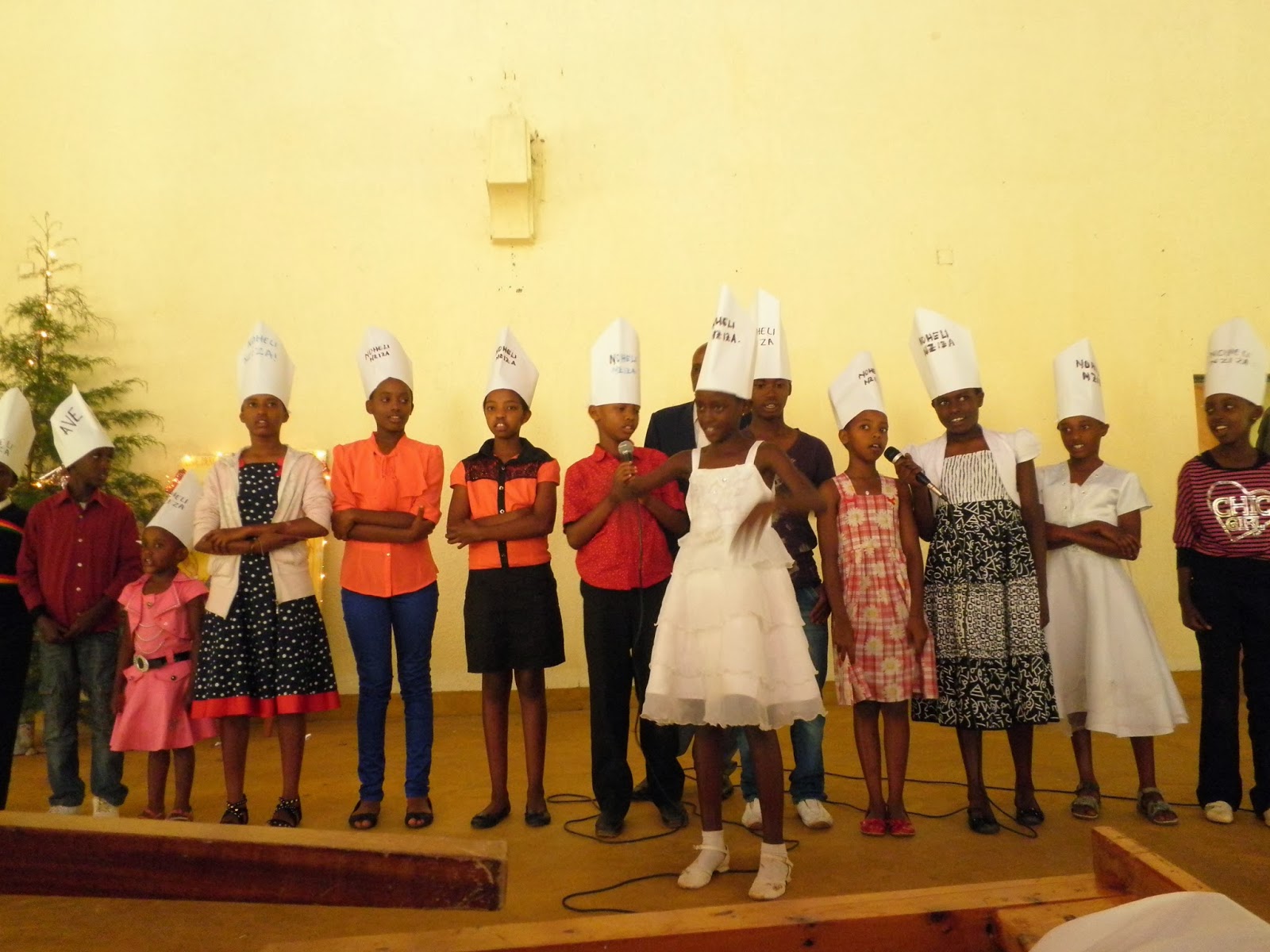
 I spent Christmas Day with the local members of the Emmanuel Community, the international Catholic community to which I belong. 120 of us went to a nearby Benedictine monastery and spent the whole day there. We sang praise songs, had Mass, watched the children perform a Christmas play
 , ate lunch, played games outside, and danced. During an interlude between activities, I was even convinced to sing and play guitar for a few songs (how happy I was to play a guitar for the first time in 5 months). One thing I noticed during the dance is that with the Emmanuel Community members, and in Africa in general, I am willing to risk looking dumb or uncool or whatever. Normally I don't like dances that are free form, people dancing in a circle, etc. I always felt insecure and like I wasn't a good dancer, but here, I soon got over it and enjoyed myself. I think it's because the Rwandans are impressed whenever I participate in their cultural activities so that gives me some street cred no matter how I look or sound.
 | |
| Only part of our circle as we played games |
 Dec. 26 and 27 were days to spend around the house. I spent lots of hours in the garden, including harvesting and shelling black beans. I tried again to make a Mexican meal and again, it wasn't the greatest. Chickpea and corn flour crepes are a great improvement on the corn tortillas I tried to make in my first weeks here, but still, they aren't to the level of ordinary tortillas. Rita and I did venture out to have dinner at the house of an Emmanuel Cty family that is in my small faithsharing group. They really laid out a spread, as you can see in the picture. There were French fries, rice, green bananas, meat, sauce, and salad. We brought a pumpkin cake, again, the fruit of our garden.
On the morning of the 28th, we headed back to Kigali for the second half of our vacation. This time around, there was a lot of lounging around Megan's house as we talked, read, or slept. We were graced with the presence of Fr. Mike Rapp from the Denver archdiocese. He is currently studying in Rome and was in Uganda with a priest friend from there. He took a short trip down to see Megan and visit the shrine of Our Lady of Kibeho. One benefit of having a priest around is that we three ladies and Timothee, the French Fidesco volunteer working in Kigali, were able to have a private Mass in English on Saturday night. This was super helpful to Rita, Timothee, and I because we had an early morning departure the next day to go to Akagera National Park. Without the Saturday night Mass, which is rare in Rwanda, we would have had to make sure we were back in time to go to a Sunday night Mass, which is also not easy to find. But since we had our intimate Mass, we were carefree as we were picked up at 5:30 am on Dec. 30 for the 2 hour drive to Akagera NP.
Akagera preserves Rwanda's savannah so we were able to go on a safari drive. I could call it a poor man's safari because it costs significantly less to go there than a normal safari would, but I guess the animals aren't as plentiful. I didn't mind though. I was impressed by what we did see, which were zebras, giraffes, impalas, water bucks, monkeys, baboons, buffalo, warthogs (Pumba, anyone?), hippos, and birds. The drive took most of the day. We started with our guide at 8:30 am and finished around 2 pm. Then there was the long drive back to Kigali. Here are some of the best pictures of the animals.


 |
| Sadly, the hippos didn't get much higher out of the water for us |
 |
| Two males |
 |
| Impalas: one male and the rest are female |
 | ||
| Buffalo in the background |
 After the trip to Akagera, the rest of the time in Kigali was quite relaxed. I read a book about the process of forgiveness and
reconciliation after the genocide. We visited the Kigali Genocide Memorial, where there is a museum about the Rwandan genocide and other genocides around the world and the mass graves of over 250,000 people. The stories really are horrific, but almost as unbelievable as the atrocities people can commit against each other is the forgiveness people have been able to offer their family members' killers afterwards. Other than heavy stuff, Rita and I visited the home of one
of our students, Lisa, who will be in Senior 2 this upcoming year. She's the one on the right in the family picture. The
family fed us lunch and sent us home with a small bag of peanuts. The
visit with them was very warm and I truly felt the hospitality of the
Rwandans and perhaps the pride they had at welcoming people from Lisa's
school, especially foreigners. It was a treat for us and we would have visited other students, but we either didn't have their phone numbers or we had incorrect ones. I went out to eat with Megan at a posh outdoor Asian restaurant
and enjoyed some curry (expensive by Butare standards, but normal for
Kigali). I had lunch with an Emmanuel couple, Edith and Silvere, who are currently serving with Fidesco in Zambia. I went bowling with Christine and Michael and their kids (that's the Butare American family who is in Kigali after the birth of their son). The alley has 6 lanes with real gutters and balls, but what is so funny about the setup is the man who hides behind a curtain and removes the downed pins by hand. I spent the night of New Year's Eve at another EC family's home. I had met the married daughter and son-in-law and a brother at the Christmas gathering. They had me over for refreshments on the porch, dinner, and then unexpectedly, a sleepover. Midnight wasn't a celebratory event like it is in the States, at least not in their house, so that was a bit of a disappointment. We did drink hot milk from their cows, though, which is a sign of being given a blessing. The next morning, I volunteered at the Missionaries of Charity orphanage and then made my way back to Butare. Now I'm preparing for the return of the students this weekend. I'm sure it will be great to have them back, but since they've been gone for two months, I've gotten used to having a more flexible schedule and more free time. Surely there will be an adjustment period, especially as I begin my full schedule of teaching!
After the trip to Akagera, the rest of the time in Kigali was quite relaxed. I read a book about the process of forgiveness and
reconciliation after the genocide. We visited the Kigali Genocide Memorial, where there is a museum about the Rwandan genocide and other genocides around the world and the mass graves of over 250,000 people. The stories really are horrific, but almost as unbelievable as the atrocities people can commit against each other is the forgiveness people have been able to offer their family members' killers afterwards. Other than heavy stuff, Rita and I visited the home of one
of our students, Lisa, who will be in Senior 2 this upcoming year. She's the one on the right in the family picture. The
family fed us lunch and sent us home with a small bag of peanuts. The
visit with them was very warm and I truly felt the hospitality of the
Rwandans and perhaps the pride they had at welcoming people from Lisa's
school, especially foreigners. It was a treat for us and we would have visited other students, but we either didn't have their phone numbers or we had incorrect ones. I went out to eat with Megan at a posh outdoor Asian restaurant
and enjoyed some curry (expensive by Butare standards, but normal for
Kigali). I had lunch with an Emmanuel couple, Edith and Silvere, who are currently serving with Fidesco in Zambia. I went bowling with Christine and Michael and their kids (that's the Butare American family who is in Kigali after the birth of their son). The alley has 6 lanes with real gutters and balls, but what is so funny about the setup is the man who hides behind a curtain and removes the downed pins by hand. I spent the night of New Year's Eve at another EC family's home. I had met the married daughter and son-in-law and a brother at the Christmas gathering. They had me over for refreshments on the porch, dinner, and then unexpectedly, a sleepover. Midnight wasn't a celebratory event like it is in the States, at least not in their house, so that was a bit of a disappointment. We did drink hot milk from their cows, though, which is a sign of being given a blessing. The next morning, I volunteered at the Missionaries of Charity orphanage and then made my way back to Butare. Now I'm preparing for the return of the students this weekend. I'm sure it will be great to have them back, but since they've been gone for two months, I've gotten used to having a more flexible schedule and more free time. Surely there will be an adjustment period, especially as I begin my full schedule of teaching! |
| Judith, Charlotte, and I at the bowling alley. The seats are way better here than in the US. |

Tuesday, December 24, 2013
The Missionaries of Charity Orphanage and Christmas Plans
.JPG) Rita and I have started our Christmas vacation. We are using vacation days to have off from December 18-January 1 so here is the news on how we spent the first half of the break and what I will do for Christmas (everyone asks).
Rita and I have started our Christmas vacation. We are using vacation days to have off from December 18-January 1 so here is the news on how we spent the first half of the break and what I will do for Christmas (everyone asks).On Wednesday, December 18, Rita and I took the bus to Kigali, the capital. Kigali sure is a different world from Butare. There are skyscrapers, ethnic and expensive restaurants, cars everywhere (which cause rush hour traffic jams), grocery stores with products from the U.S., Europe, and India, and white and Asian people. On one hand I could get used to such a life in Rwanda, but on the other hand, it didn't feel African enough. I stayed until Sunday night, but Rita returned home on Saturday morning. We stayed with Megan Lyons, an American girl that I was in email contact with through a mutual priest friend from CO. Her roommates went home for Christmas so she had room for us. She was super hospitable and showed us around. The best part about staying at her house was the huge screened in front porch (Minnesotans would be jealous). We ate our meals out there and read in the morning on the outdoor couch. I would like a porch like that.
What did we do? The highlight was volunteering at the orphanage run by the Missionaries of Charity (Mother Teresa's sisters). Unfortunately taking photos isn't allowed so I don't have great pictures to accompany this post. We arrived on Wednesday in time for the afternoon visiting session from 3-6 pm. We returned on Friday for both sessions, staying from 9:30 am-12 pm and then 3-6 pm. It was a joy to be with the children, but it was also eye-opening, shocking, and saddening. Let me explain the disheartening part first. The orphanage has two main day rooms and a playground where the children spend their waking time. One room is for the babies and I counted 21 babies. There are metal cribs lined up all around the room, one right next to the other. There is a mat in the middle of the room for the babies to sit and lie on. I don't remember seeing any toys. In the other room, there are 12 special needs kids (maybe 2-8 years old and mostly suffering from what looks like severe cerebral palsy) and 12 able-bodied kids (~2.5-5 years old). One part of the room has tables for meal time and the rest has two cribs, plastic chairs, and a mat. Again, I saw very few toys, just a stuffed sheep and a Matchbox car. The outdoor play area did have a swing set, a slide, and a merry-go-round. Each room had 2-3 staff workers to attend to the children and sometimes the sisters would come down to hold the babies or visit the older children. You can imagine 24 kids, experiencing the terrible twos or needing to be fed or acting up out of boredom or the desire for attention, being managed by 3 workers and whatever volunteers are there that day. If I had to pick an orphanage to live at, one run by the Missionaries of Charity would guarantee I would be treated as a person with dignity and worth so that is where I would choose to be, but still, it's an orphanage. There aren't enough workers/volunteers to give each child the affection and attention they need and desire, which they would have a better chance of having in a family
 |
| The rough road the orphanage is on |
A sad fact that I learned while there is that the odds of the kids being adopted into families aren't great because foreign adoptions from Rwanda aren't allowed currently, which means only Rwandan nationals can adopt. That breaks my heart because there are so many kids in orphanages and I know so many of you and given the chance, I would try to win your hearts over to one of these kids so they could become a member of your family. If I was married and there wasn't a foreign ban, I know which kid I would want to bring into my home. Her name is Jessica and I would guess she's around 5 years old. The first day she came across as a trouble maker, crying a ton when she wasn't allowed to do what she wanted to do, taking the few toys from other kids, not listening to the workers, etc. On the second day I decided to not react to the bad behaviors she displayed (thereby not giving her attention when she was acting up), but then to call her to me and give her attention when she was being good. It worked! She quickly got bored with taking the brush I was using to comb a toddler's hair (my first time combing and braiding African hair!) and put it down. Then at the end of the day, I pulled her into my lap and we had 10 minutes of one-on-one time. I tickled her, gave her hugs, showed her how to make different sounds with my mouth that she tried to imitate, and protected her from a handicapped adult (also present on the compound) who would reach out to bop her on the head or shoulder. One time she stuck out her tongue and blew raspberries at me and I told her, "Oya. If you do that again, I'll put you on the ground." She smiled and a minute later, this time did it away from me. I said it again and then she stopped. That showed me that she can and will be good if she gets positive attention. And as my mom pointed out, since she's probably the oldest able-bodied kid in the group, she is probably bored and acts out to have something happen, even if it's negative attention.
The best part about being at the orphanage was getting to give love to all those kids. I tried to spend some time interacting with each of the special needs kids by holding them (such as one boy who is five years old but has a very small body and can't move or talk because he has fluid in his brain) or picking them up by the arms and hands and helping them walk awkwardly around the room. Even though none of those kids can communicate, I could tell that some of them understand what is going on and what is said to them because they would smile when I called out their name or beckoned them, get agitated when I put them down on the floor to move onto another child, and get excited when it was their turn to walk. At one point I had three of the boys lying on my legs and one would laugh so much when I tickled him, another wanted me to hold his hand, and the other wanted me lie on me also. For the able-bodied kids, I didn't spend as much one-on-one time with them, but I took turns pushing a few of them on the swing or inviting a group to sit on the merry-go-round so I could push them in it. I helped a few of the younger ones finish their food when they were tired of feeding themselves. As I wrote earlier, I was given a comb, brush, and a bottle of oil and asked by one of the sisters if I could comb a toddler's hair. It was my own initiative to braid it.
.JPG) |
| Meze Fresh and a burrito with goat meat |
After Rita went home, I attended the national Emmanuel Community weekend retreat in Kigali. Each day there was praise, Mass, adoration, and a talk. Everything was in Kinyarwanda and while people translated for me, I often lost focus and then fell asleep during the long talks. The highlight of the retreat was getting to meet community members from other parts of Rwanda and staying at the home of a newly married couple. Agnes and Placide speak English well enough so we stayed up late socializing and eating. The differences between American and Rwandan traditions and culture is always a source of hours of conversation. I took the bus home with members of the EC, once again with one more person per row than the number of seats, and arrived home with lots of joy.
 |
| Our Charlie Brown Christmas tree, made of spruce branches tied together |
Sunday, December 15, 2013
One of my Side Missions and a Garden Update
Early on in my Rwandan time (2 days from now marks 4 months already), I was asked by the priest across the street if I would be willing to teach English one hour a week to the eight novices who live with him (one Rwandan, one from the Central African Republic, one Congolese, and five Cameroonians). [Novices are men in their first year of studies to be priests for a religious order/congregation, such as this group of men who are with the Missionaries of the Sacred Hearts.] Since I didn't have any regular commitments yet, I agreed and for probably 3 months now, every Monday I walk across the street to teach from 8:30-9:30 pm.
It is such a joy for me. Sometimes I feel lazy and hope that when I ring the bell at the gate, no one will answer so I can go home and have a free evening. That doesn't happen, though; the door in the gate opens and I am greeted by Gustin, Albert, Ivan, Fidele, Gideon, Archange, Shadrach, or Wilfred and I instantly feel happy to be there. I walk into the classroom and some of the men are waiting at their desks for me; we greet each other, ask about the week, and soon the last man arrives.
Since I'm not an English teacher by profession, I'm making up the lessons as I go. I use grammar books I borrowed from the school library to get an idea of what I should teach first and how to teach it. I'm grateful for the books and the grammar section in my English-French dictionary because they clue me in to the rules of the English language, things I might have learned in school 20-25 years ago but have long since forgotten. Now I don't remember many of the rules; I just know what sounds right when speaking or writing, which doesn't help a ESL learner learn (such as why some simple present verbs end in an "s" and some don't, as in the example, "I like" and "he likes").
Anyway, the topics aren't the reason why I'm writing this entry. It's to share what a joy it is to have the opportunity to teach them and to become a part of their community and them a part of mine. What I love about being them is watching them razz each other about all sorts of things, listening to them laugh (often), seeing their kindness towards me and their brotherhood with each other. I always come home from teaching them filled with joy and contentment. I also occasionally attend Mass in English on Tuesday mornings at their house and I smile to hear them say the words of the Mass in English (the fruits of our first lessons together) and to watch them play their instruments and sing songs of praise. They get so into it. I already know that when I look back on my time in Rwanda, I will fondly remember my one hour a week with the novices and then I'll laugh. They always make me laugh.
 Here is an example of how they have become a part of my community and me a part of theirs. Last Monday we were talking about the months of the year and I had them tell me when their birthdays are so they could practice saying dates in English. Fidele said his was Dec. 10, which was the very next day. I asked the other men if they were going to do anything special for Fidele, like have a birthday cake or a party. They started joking about having nothing special and in fact, they were only going to drink water (see what I mean about razzing each other?!). I decided that I would make the day special for him so the following day, Fidele's birthday, I made a cake and arranged with another one of the novices for my roommate and I to come over at the end of dinner to surprise Fidele with it. It turns out he was the one to open the door for us so we shooed him away, put the candle in the cake, and walked into the dining room singing Happy Birthday. Soon the dispersed novices were all gathered in the room, joining us as we sang Happy Birthday in many languages, and Fidele blew out his first ever birthday cake candle. He's had birthday cakes before but never with a candle. Needless to say, he was really touched (and soon covered with flour, courtesy of the other novices) and Rita and I spent 2.5 hours laughing and eating with him and the rest of the novices. I plan to continue the tradition of honoring each of their birthdays with a cake.
Before I end this post, I wanted to include a quick garden update because I was looking at last month's pictures and I can't believe how much the garden has grown. Here is one of the pictures taken November 18 that made it into an earlier post. The corn is so small. There's a lot of soil showing. Then the picture from five days ago shows a radical transformation. The corn stalks are huge (some are taller than me) and growing extra support/stabilizing fingers near the base. The lettuce grows faster than we can eat it. The carrot tops are full. The onion tops stand a foot high. The cucumbers have climbed high up the sticks I imbedded next to them and tomorrow I'll pick off the first cucumber. A few days ago we cut the first mystery gourd but have yet to cut it open. I think it will be time to harvest the red beans soon. It truly is amazing to see how fast and big everything can grow with just sunlight, water, and soil nutrients.

 | ||
| In front: Shadrach, Archange, me, Fidele, Wilfred, Gustin, Albert In back: Gideon, Ivan |
Since I'm not an English teacher by profession, I'm making up the lessons as I go. I use grammar books I borrowed from the school library to get an idea of what I should teach first and how to teach it. I'm grateful for the books and the grammar section in my English-French dictionary because they clue me in to the rules of the English language, things I might have learned in school 20-25 years ago but have long since forgotten. Now I don't remember many of the rules; I just know what sounds right when speaking or writing, which doesn't help a ESL learner learn (such as why some simple present verbs end in an "s" and some don't, as in the example, "I like" and "he likes").
Anyway, the topics aren't the reason why I'm writing this entry. It's to share what a joy it is to have the opportunity to teach them and to become a part of their community and them a part of mine. What I love about being them is watching them razz each other about all sorts of things, listening to them laugh (often), seeing their kindness towards me and their brotherhood with each other. I always come home from teaching them filled with joy and contentment. I also occasionally attend Mass in English on Tuesday mornings at their house and I smile to hear them say the words of the Mass in English (the fruits of our first lessons together) and to watch them play their instruments and sing songs of praise. They get so into it. I already know that when I look back on my time in Rwanda, I will fondly remember my one hour a week with the novices and then I'll laugh. They always make me laugh.
 Here is an example of how they have become a part of my community and me a part of theirs. Last Monday we were talking about the months of the year and I had them tell me when their birthdays are so they could practice saying dates in English. Fidele said his was Dec. 10, which was the very next day. I asked the other men if they were going to do anything special for Fidele, like have a birthday cake or a party. They started joking about having nothing special and in fact, they were only going to drink water (see what I mean about razzing each other?!). I decided that I would make the day special for him so the following day, Fidele's birthday, I made a cake and arranged with another one of the novices for my roommate and I to come over at the end of dinner to surprise Fidele with it. It turns out he was the one to open the door for us so we shooed him away, put the candle in the cake, and walked into the dining room singing Happy Birthday. Soon the dispersed novices were all gathered in the room, joining us as we sang Happy Birthday in many languages, and Fidele blew out his first ever birthday cake candle. He's had birthday cakes before but never with a candle. Needless to say, he was really touched (and soon covered with flour, courtesy of the other novices) and Rita and I spent 2.5 hours laughing and eating with him and the rest of the novices. I plan to continue the tradition of honoring each of their birthdays with a cake.
 |
| The garden on November 18 |
 |
| The garden on December 10 |

Saturday, November 30, 2013
Pilgrimage, Birthday, and Thanksgiving All Wrapped into One
It's always interesting to be in a foreign land on such a big American holiday as Thanksgiving and one's birthday, but since that is often the case with me, I try to make the best of it by gathering whatever friends I can for a Thanksgiving feast and doing something special for my birthday. This year, definitely the most "foreign land" I've ever been in for the two occasions, did not disappoint.
This year my birthday fell on Thanksgiving. It was also the 32nd anniversary of the first appearance of Mary to a high school girl in Kibeho, Rwanda. November 28 was also when the director of Fidesco (who lives in France) was going to visit the volunteers in Butare with his wife. It was a quadrifecta of events to celebrate, all on one day. This was definitely going to be a birthday/Thanksgiving to remember and it began with a pilgrimage to Kibeho.
 |
| My pilgrimage partner, Paul |
 |
| The Vigil Mass with the Chapel of the Seven Sorrows in the background |
Well, thanks to God's providential timing, I was able to walk to Kibeho and have a bed to sleep in. What great birthday gifts! A Colorado girl, who works with Mother Teresa's sisters in Kigali, happened to meet an American Air Force engineer who was traveling to Kibeho for the feast day too. She told him about me and said I was looking for someone to walk with, so Paul, even though he arrived in Kibeho on the 26th, took a bus back to Butare on the morning of the 27th so I could have someone to walk with. He also offered me his room at the pilgrims' house and volunteered to sleep outside, which he didn't end up having to do because he roomed with two Emmanuel Community/Fidesco men from Kigali who were staying at the same place. What a gentleman!
 |
| The Fidesco/Emmanuel group with Anathalie, the visionary |
The Mass for the feast day of Mary, Mother of the Word, or Our Lady of Kibeho, was full of interesting sights and things to ponder. First, the gospel reading was from John 1, which is all about Jesus being "the Word" which came down from heaven. I thought that choice for the Gospel for the feast of Our Lady of Kibeho was very telling. I know some of you who read this blog are Protestant and probably wonder why we Catholics spend so much time loving Mary, but this feast shows that when Mary appears in the world, it's to help people love and know her Son better. People were drawn to Kibeho on the 28th because Mary appeared there, but once she gets us there, the Mass calls us to mediate on Jesus who is the Word. The Word that created the universe. The Word that gives us life. The Word that heals us (I think of the line in Mass which says, "Lord, I am not worthy that you should enter under my roof, but only say the word and my soul say be healed." After the feast day, the meaning is different for me: "Only say Jesus, who is the Word, and my soul shall be healed"). Another interesting thing was when the bread and wine are presented to the bishop in the middle of the Mass. This part of the Mass is called the "presentation of the gifts" and it's a time when all of us in the congregation are supposed to place our spiritual, physical, mental, etc. sacrifices before the Lord along with the bread and wine. At this Mass, though, people brought literal gifts to the altar, just like in the Old Testament. People brought sacks of potatoes, buckets of laundry detergent, mops; you name it, they brought it.
 |
| Some of the gifts brought before the altar |
Lastly, at the end of Mass there was the blessing of religious articles and water. When Mary would appear, she would bless buckets of water that were in front of the visionaries and then the visionaries would walk through the crowd sprinkling the people. Sometimes the visionaries would even tell Mary that the people were thirsty and needed water and then it would begin to rain. Luckily we didn't get rained on the entire pilgrimage, but the priests did walk through the crowd sprinkling holy water on everyone and the jugs of water they held up. Here is a link to a video I posted on YouTube of the crowd praising during the song of thanksgiving after communion: http://youtu.be/pmBqWkFbpAs
.JPG)
.JPG) |
| Sitting down to Thanksgiving dinner |
After the religious celebrations, I caught a ride back to Butare with the Fidesco Kigali team and started preparing Thanksgiving dinner. Because this post is getting long winded, I'll make this part short. Rita and I had the French volunteers in town, the international director and his wife, the French volunteer in Kigali, and the Rwandan Fidesco employee to our house for Thanksgiving dinner. We made stuffing with dried sausage, mashed potatoes without gravy, green bean casserole, corn fritters, and sweet potato pie. You'll note the absence of turkey. No day-after turkey sandwiches for me. Dried cream of mushroom soup and homemade fried onions went into the casserole. One can of corn went into the fritters, which cost less than having enough canned corn for creamed corn. Sweet potato pie is dense, but it turned out perfectly. Segolene, the French mom, made a carrot orange cake, which became my birthday day loaded with candles. Her children drew pictures for me as birthday gifts and Segolene and Rita gave me a skirt that is just my style. It was definitely a birthday and Thanksgiving I'll never forget.
.JPG) |
| 31 years old! |
.JPG) |
| Sweet potato pie |
Subscribe to:
Posts (Atom)